
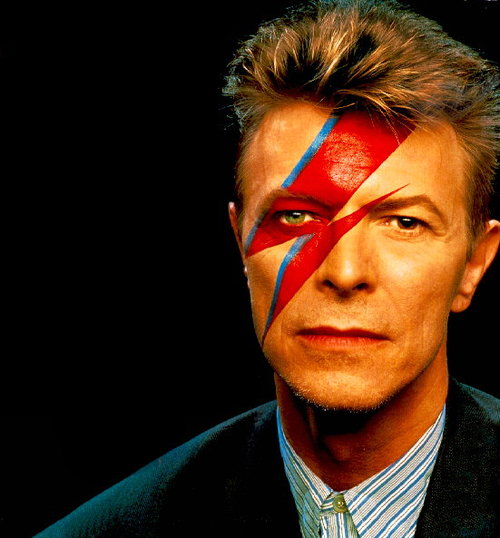
Everyone has their own taste, their own likes and dislikes. Music is a hugely varied form and what we love or hate or don’t really get is entirely personal. All that said, can we all just agree on one thing: David Bowie is without parallel, an absolute genius who is just a little bit better than anyone else?
I went through my first Bowie phase at about 16 and never really came out of it. I’d liked everything of his that I’d heard – as a kid, Life On Mars was the first song to give me those chills that music can send through your body – but it was listening to the Ziggy Stardust album that really blew me away. It opened me up to different kinds of music and to what music could really be. Ziggy remains my favourite ever album. I love the way it seems to suggest a story, Five Years to Rock n Roll Suicide, the perfect songs, that iconic early Bowie vocal. And that last song, Rock n Roll Suicide – that ending, goodness me, I didn’t know music could do this. ‘Oh no, Love, you’re not alone!’ – just what every teen needs to hear – and Bowie’s Messianic screams of ‘Give me your hands’…like he was reaching out of the record to me. It sent tingles through my spine, my brain, my very self. I played that album constantly and it still endures today. It changed how I saw music – and by doing that, it changed my life.
Bowie’s back catalogue became an obsession. There was no Spotify, no internet and in my case, not much money to buy records, which was the only way to hear them. From birthday to birthday, I gradually bought the lot. I started with Diamond Dogs, an album a lad at school had played while babysitting and turned off because it scared. him. Again it felt like a story, a post-apocalyptic nightmare world. Sweet Thing/Candidate, one of Bowie’s least heard, most remarkable tunes, is its centrepiece, Rebel Rebel its enduring smash hit. Hunky Dory, which many cite as their favourite, just a brilliant collection of iconic songs. Aladdin Sane, the perfect Ziggy Album after Ziggy, the sweeping heavy rock meets peculiar ballads of The Man Who Sold The World. Space Oddity or David Bowie – whatever you call his first record after his novelty pop debut – such a clear prognosis of the brilliance to come and including another little heard classic in the epic Cygnet Committee.
Early Bowie was my thing now. I was almost dismissive of Let’s Dance, his most successful album, as were many Bowie fans at the time. I listen to it now and am bewildered by that indifference; it’s a fabulous album – but my view was not uncommon. But I think my view of Let’s Dance changed not just with maturity, but with hearing the massive section of Bowie’s collection that I had not yet caught up with.
It’s from the mid to late 70s that the Bowie story takes an incredible turn. Here is a man who has invented glam, changed fashion, influenced social mores and turned out a series of albums that would cement his legacy as one of the all time greats. But in 1975, Young Americans saw his first, remarkable reinvention. No longer the weird red mullet and glam rock tunes; suddenly Bowie’s voice went several octaves deeper and he started turning out white soul music. It was not just any soul music either, as with any genre he accosted, it had a distinct Bowie tinge. From there to the inestimable Station to Station, which built on its predecessor and slightly foreshadowed the Berlin trilogy to come – six sweeping rock/soul tunes that legend has it was put together on a diet largely made up of milk and cocaine.
Bowie was wasting away and going slightly nuts, saying bizarre things in interviews about Hitler and looking more like an alien than ever – perfectly cast in The Man Who Fell to Earth. He retreated to Berlin, where he and his friend Iggy Pop tried to pull themselves together. The Berlin trilogy would follow – and Low, the first of the three, was a seismic shock to his record company. This was an entirely different Bowie again – while the first side was a series of short vignettes reminiscent in some ways of Station to Station, the second was almost entirely instrumental. The keyboard-heavy compositions, the phonetics instead of words – you can imagine what marketeers used to hit records like Starman and Space Oddity thought. Low is another album that changed music forever, it was reportedly the inspiration for Joy Division ( initially named Warzawa after a Low track) and for a whole genre of electronic music. Heroes followed in a similar vein; the second side largely instrumental ambience, the first a collection of great electronic rock songs, including the stupendous title track. Then came Lodger; the last of the trilogy was different again, experimental in a different way as Bowie tried different styles, but still able to produce the perfect pop of Boys Keep Swinging.
Scary Monsters is so good that ‘best Bowie album since Scary Monsters‘ became a thing in the following years where some detected a decline. A clear precursor to the 80s new romantic scene, even featuring some of its early fashionistas in the Ashes to Ashes video, Scary Monsters is up there with Bowie’s greatest material and sparked a new string of hit singles. Let’s Dance, on which Bowie worked with the legendary Nile Rogers, would follow, a massive international success which, as alluded to earlier, initially divided some of the fanbase.
That catalogue up to 1983 is just unbeatable and for a long time, the later years were somewhat dismissed. Certainly the two further 80s albums, Tonight and Never Let Me Down, are somewhat forgettable, but every Bowie album has a gem or two. Blue Jean and Time Will Crawl, for example, are great Bowie songs. And one-off single Absolute Beginners is magnificent.
Moving in to the 90s and out of what Bowie later derided as his ‘Phil Collins phase’, Black Tie White Noise is not quite the return to form that some claim and The Buddha of Suburbia (only recently counted among the studio albums) is interesting but uneven. The real return to form came with Outside in 1995, a dark album about an ‘art crime’ murder which risks being derailed by some weird spoken segments, but shows there is plenty left in the Bowie tank. Then came Earthling, his take on drum and bass which is a surprising success. 1999’s Hours rounds off Bowie’s decade nicely with a strong collection of songs. Bowie was writing good songs and albums again now, though he had become a more marginal figure and his releases were not quite the events they had been in the past. He remained a cultural icon and his predictions about the potential power and dangers of the internet would be reprised in later years as evidence of his deep wisdom and foresight. His musical recovery is built on by the acclaimed 2002 album Heathen and its more mixed successor Reality.
A heart attack which ended a gig in 2004 would see the end of Bowie’s tours and, it seemed for a while, his whole musical career. He simply disappeared. Fans seemed to have been left with a legacy of his great, era-defining music, with his ‘greatest hits’ tour of 2000 and, quite honestly, that would have been more than enough. His sudden re-emergence in 2013, ten years after Reality, stunned both the media and his fanbase. Where Are We Now?, the gorgeous single, rocketed to the top of playlists and the subsequent album The Next Day is right up with his very best. Suddenly, Bowie was centre stage again, though he remained elusive, not giving interviews and just letting his music speak for him.
We didn’t know that Blackstar would be his farewell. Bowie did. He admitted as much to his friend and producer Tony Visconti – who he had confided in about his terminal illness. Blackstar is another astonishing departure, it sounds like nothing else, taking in jazz, hip hop and electronic influences and fusing them in to a Bowie classic. And the lyrics – man, some of the lyrics will break your heart. The title track, Lazarus and Dollar Days (‘If I never see the English evergreens I’m running to…’) in particular. Those last two Bowie albums are incredible, an ageing and then dying artist returning to his absolute pomp.
Bowie’s death in 2016 impacted me more – way, way more – than any celebrity death. It felt like losing someone close to you, even though I know that makes little sense. But when you have listened to someone’s music so closely over so many years, admired them above almost anyone else – their departure does hurt. He went out in a blaze of brilliance; even his end felt choreographed. A world without David Bowie is just a lesser place.
Every so often , I go through a phase of listening to Bowie and nothing else. When I do, it just confirms that – to me – there is nobody better. I have eclectic musical taste and tend to have phases of playing particular genres. But Bowie is his own genre; he spanned many different ones but when I listen to him now, it all hangs together as uniquely him. This was a man who not only wrote great songs and fantastic albums; he also designed his own sets, album sleeves and clothes. He almost single handedly introduced the idea of conceptual art to pop; he was the first pop star to switch genres and image at will; he popularised arguments about sexuality and gender long before they were fashionable. That iconic Top of the Pops appearance with his arm on Mick Ronson’s shoulder, the wearing of a dress on the original cover of The Man Who Sold The World – Bowie was always a transgressor, a disrupter ahead of his time. His ability to tune in to the zeitgeist, to lift from what was not just popular but emerging and make it his own, is without precedent.
And, good God, he wrote some incredible tunes.
 Rory writes