
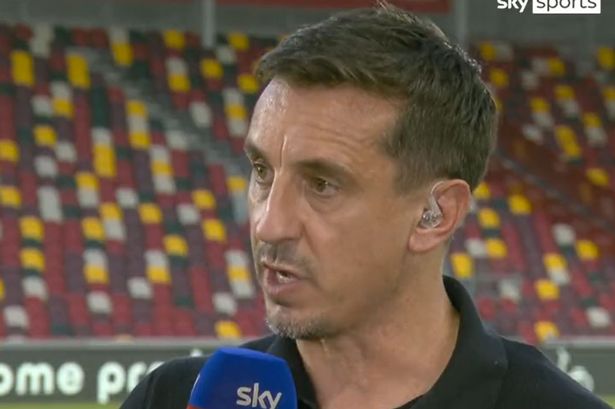
Gary Neville’s impotent fury at Manchester United’s latest humiliation may be a delight to some (go on, that includes me), but it highlights once again his inconsistency when it comes to the role of big money in modern football.
In his rant at the affable Jamie Redknapp – who you felt was rather enjoying himself – Neville laid the blame for the club’s decade-long malaise at the hands of the Glazer family who own the club. He cheerfully (well, angrily) ignored the fact that under the same owners., Manchester United swept all before them under Sir Alex Ferguson. He hit the roof at the suggestion that the club had spent a huge amount of money on players. And it seems he would prefer a different kind of owner. “The only money that has been spent on players is the money the club has generated or that it’s borrowed. It does not come from the family. Let’s get this out of our heads that the Glazer family are putting money in like Roman Abramovich did, like the Saudi Arabians are doing at Newcastle, like Sheik Mansour has done at Manchester City…”
The italics here seem to illustrate what Neville regards as ‘good’ owners in modern football. Owners who spend their own cash – in each of these cases, pretty ill-gotten – to throw money at football clubs. He has no concern that Newcastle and Manchester City, like Chelsea under Abramovich, are sports-washing operations. All three have ploughed in gargantuan, unprecedented funding to football teams in order to boost reputations that could at very best be described as tarnished. Manchester City and Newcastle are run by arms of the United Arab Emirates and Saudi Arabia, states with a highly dubious human rights record. Abramovich is pretty much a gangster whose vast wealth originates from kleptocracy following the collapse of the USSR; he is close to the Russian state and a former Governor of Chukotka.
Sports washing works: whether this is exemplified by Abramovich’s name being sung at Chelsea games or City fans on Twitter defending the UAE as not as bad as some neighbouring states – or lauding their owners for putting money into local communities in Manchester. Its impact is also shown when Gary Neville – not for the first time – lauds the owners of all three clubs for ‘putting their hands in their pockets’, without any reference to how their pockets became so full.
It is a strange contradiction that the man who arguably led the fight against the breakaway European Super League and rightly called out the greed of all the clubs involved seems to want one of Britain’s great institutions, Manchester United, to be run by a state or a sugar daddy with a reputation to polish. Perhaps we should not be so surprised, as the money Neville and others have poured in to Salford City has certainly impacted competition lower down the football pyramid – though not on the enormous scale that Chelsea and Manchester City’s spending impacted the Premier League. But it is quite something to rail against rich clubs destroying vaunted competitions while simultaneously praising owners whose practices are openly anti-competitive.
The ownership model of Manchester United is certainly not a good one; it is built on debt and the owners often take money out of the club in dividends. But it is hard to see Neville’s logic in blaming the Glazers for the club’s lack of success. Over the last five years, they actually top the Premier League net transfer spend table – they have even outspent their City rivals in this period. They have spent more than twice as much as clubs like Liverpool and Tottenham and around double the amount spent by Chelsea.
Neville and others who want to blame the owners can’t say their club has not invested in players. They can criticise players who have been brought in, but those choices are not being made by the owners. They can point to other clubs’ owners putting their own money in, but that is not a model that any real football fan should welcome: the huge success of Manchester United in the past was built on money generated by the club from tickets sales, merchandising and so on. That is a sustainable and admirable sporting model – sports washing really isn’t.
Manchester United have recruited badly and will have problems shifting some inconsistent players on high wages – and in attracting top talent as their Champions League exile continues. Neville’s rage at their virtual collapse since the glory years he was involved in is palpable, but his diagnosis of the problem looks wide of the mark. and if anything, an easy, fan-pleasing target. The Glazers have simply taken the place of the previous scapegoat, former chief executive Ed Woodward.
Football is not the most important thing in the world. It can seem it to its most vociferous fans in certain deranged moments, but it really is not. We should not have football clubs owned by states or criminals and we should not celebrate off the scale transfer spending funded from questionable sources. Manchester United probably have the wrong owners, but it is ridiculous to blame them for the club’s recent demise (which is very likely to be temporary). While Neville was clearly emotional watching a team whose fans were once again claiming the renaissance would come this season get thrashed by Brentford, there is a gaping inconsistency in his campaign against the super league and his apparent wish for his club to have owners more like their neighbours. It is almost as gaping as the holes in his team’s defence.
 Rory writes