
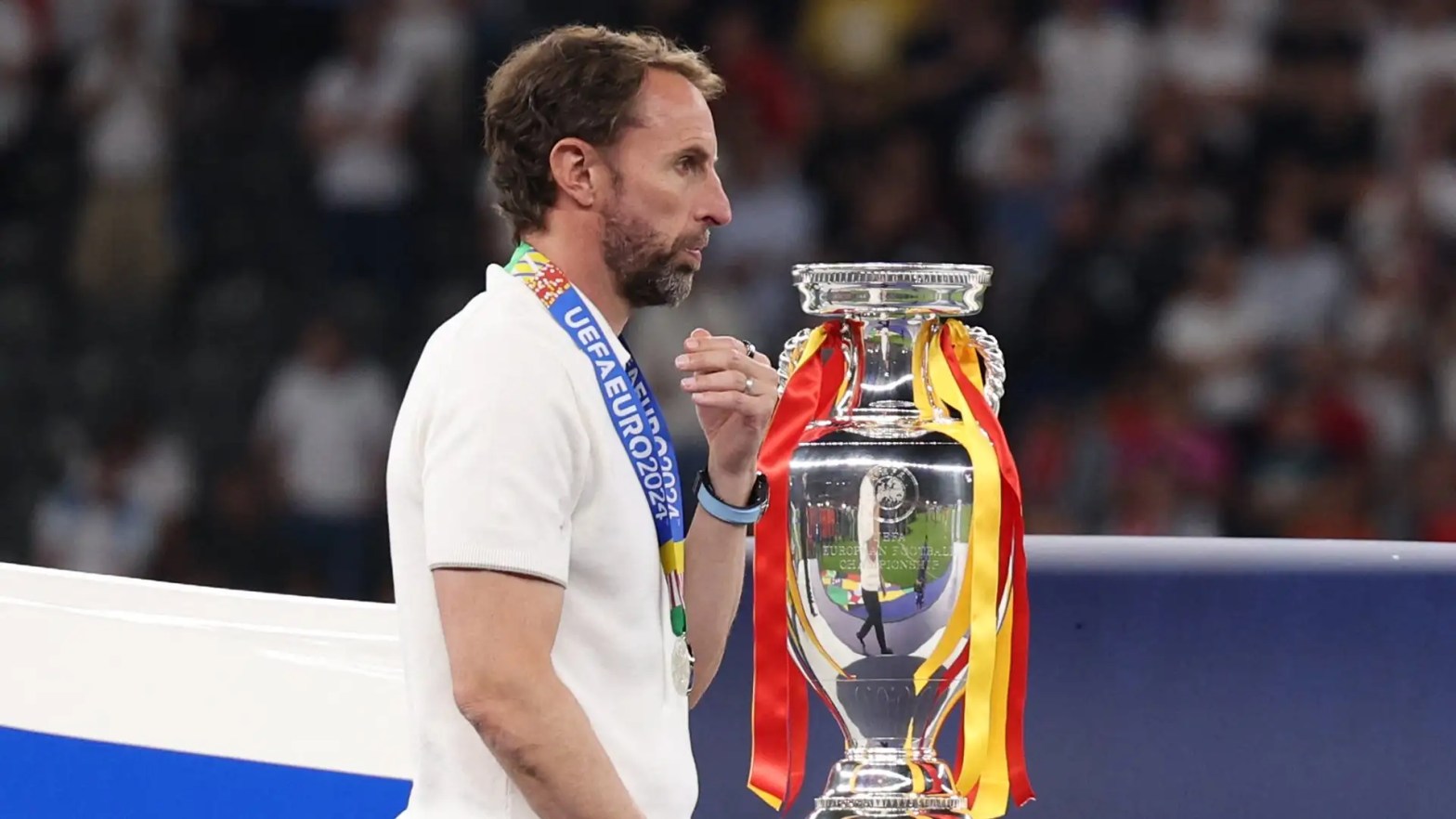
In the final analysis, at least we are spared the books, the seminars, even an update to the enjoyable if slightly deluded play. Because make no mistake, that is where we were headed. What lessons can we learn from Gareth Southgate’s success in winning an international tournament? was going to be the question and management consultants everywhere were going to be holding up the now benighted Sir Gareth as having developed a model of leadership transferable to banks, public services and FTSE 100 companies. Maybe the man himself could even have followed Adrian Moorhouse on to that particular gravy train.
And alongside Southgate: the management webinar would sit the myth of Southgate: the unfairly maligned. A man who stuck to his guns, who kept his head when all about them were losing theirs. It was already starting to happen after England finally turned up for a game – or half a game – against the Netherlands at Euro 24. ‘Put some respect on his name’ we were told, as Southgate’s record in international tournaments was trumpeted as evidence that he was maybe England’s best ever manager. And as Ollie Watkins’ brilliant late goal finally gave the nation a “football’s coming home” moment after several mediocre displays, people were starting to deny the evidence of their own eyes – hope and joy can do strange things to you.
It is of course a fact that technically, only one England manager has a better record in international tournaments than Gareth Southgate and he is the guy that won the World Cup. It’s also a fact that only a handful of nations have ever won international silverware and that it’s a bloody difficult thing to do, however good your players – because, get this, other teams have good players too. And it is hard not to like Southgate the man – he’s intelligent, considered and seemingly an all round decent individual. But none of these facts or qualities make him a great manager, or even a particularly good one.
Yes, that record looks good on paper. Since winning the World Cup in 1966, England had not made another final and had made only two semi-finals. Southgate has made two finals and one semi, taking England closer to glory than any manager since Sir Alf Ramsey. But is this due to inspired tactics and leadership, or to an outstanding crop of players and – let’s be honest – the luck of the draw?
The only major teams England have knocked out of tournaments under Southgate are Germany and the Netherlands. At Euro 24, only late moments of magic from individuals saved them from going out to Slovakia and Switzerland, and another inspired late strike beat the Netherlands. The old tradition of England losing to the first really good team they play – whether Croatia, Italy, France or Spain – has not really been overturned, they have just played them later.
Southgate was lucky to get the England job just ahead of, or in some cases during, the emergence of a number of generational English talents – Bellingham, Kane, Foden, Saka, Rice and the criminally under-used Alexander Arnold. We might not talk of golden generations any more, but this clearly is one. It is certainly a team you would expect to get past most of the opponents it did to reach the afore-mentioned finals and semi-finals. While the grim Roy Hodgson era admittedly saw a less gifted line up going out to Iceland, England’s modern record prior to that consisted of narrow exits, most often on penalties, against teams like Argentina, Brazil, Italy, Germany and Portugal
Those coming close to demanding apologies for criticisms of England’s performances prior to the semi-final at the 2024 Euros are deluded. Southgate went into an easy group with excessively cautious tactics, was almost entirely reactive in changing things that were clearly not working, misused and then discarded Alexander Arnold and persisted with players who were clearly out of form (Kane, Walker, Foden) at the expense of those clearly ready to make an impact (Palmer, Watkins and the virtually unused Gordon and Toney). Moments of individual genius rescued him twice; let’s give credit where due for sending on Watkins for another against the Netherlands.
England got to the final with their one decent performance of the competition and even that was largely confined to the first half. Jordan Pickford hoofing long balls like it was 1974, no movement up front and too many players behind the ball until England were losing characterised most of their tournament, and was the approach again in the final, where their luck ran out against a very good Spain team.
It is tempting to imagine what an England side managed by a less cautious coach would look like. Would a Jurgen Klopp – or even an Eddie Howe – set up in a 4-2-3-1 defensive formation against Slovenia? Would they find room for creative talents like Palmer and Alexander Arnold, and make more use of the pace of Watkins and Gordon? Would they over-rely on a teenage midfielder whose team had been overrun in that area all season, or use him as an impact sub? Would they take a spare left back if their first choice had not played for five months, or rely on an ageing right-footed player who was never that good at his peak?
I like Gareth Southgate as most people do, but the disappointment of another final defeat is maybe a price worth paying for avoiding the mythology that was about to develop around him. He tried his best, he got lucky with the players he had at his disposal and with the draw in tournaments. But it might not be the worst thing for football that his dated, reactive and negative tactics didn’t bring football home.
 Rory writes